

Hearing or reading the news reported by the mass media that the economy has “grown” by some percentage, many people probably wonder to whom and what has actually grown. Such an announcement is, of course, about the GROWTH of the most important macroeconomic aggregate, i.e. GROSS DOMESTIC PRODUCT – GDP. To illustrate, in Poland from 2008 to 2023 GDP growth was 264%. The values of this aggregate in each year of this period are shown in the chart below.
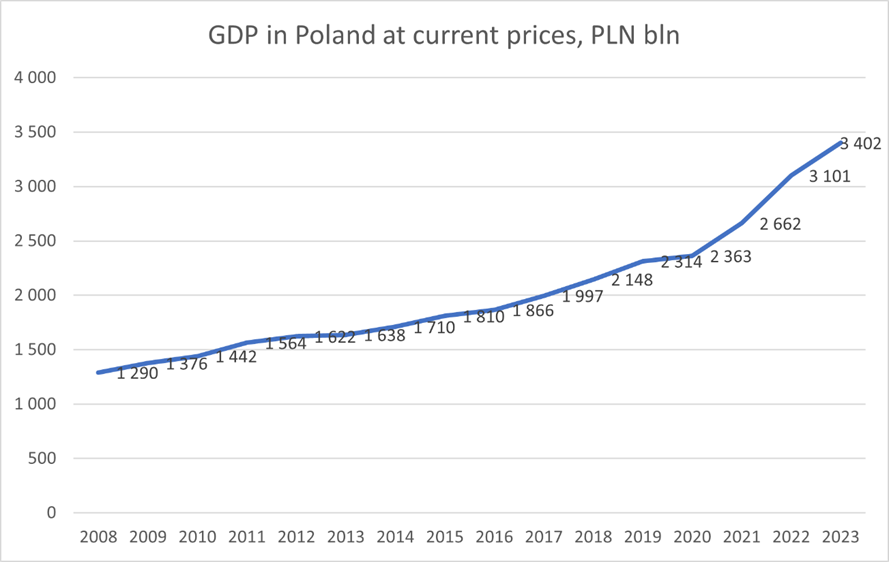
Source: Główny Urząd Statystyczny / Wskaźniki makroekonomiczne
Without going into the details of the construction and methods of calculation of GDP, I will only mention that the value of this aggregate is formed by SUMMING the VALUES of the so-called FINAL GOODS AND SERVICES produced in a given year. These are the goods and services bought by the so-called final users, i.e. CONSUMERS, INVESTORS and the GOVERNMENT (for the sake of simplicity, I omit the “abroad” sector). The part of the final products produced but NOT SOLD is treated as GROSS INVESTMENTS OF ENTERPRISES. The idea and construction of this aggregate is based on the concept of national income of the British economist J.M. Keynes, as described in his seminal work “The General Theory of Employment, Interest and Money” of 1936.
On the material side, GDP is considered as such a macroeconomic “cake” that is the result of all economic agents of a country. And this “cake” is shared by means of the incomes earned by the individual participants in the production process. The sum of these incomes is the NATIONAL INCOME (NI), which by definition should be equal to the GDP. In reality, it is never equal, and the difference can be as much as a dozen percent. However, macroeconomists don’t worry about this because they attribute the discrepancy to estimation errors. And this approach to GDP leads to a rather logical conclusion: the faster the value of this aggregate grows in general, and per capita in particular, the more the welfare of a country’s citizens improves. I write about the fact that such an approach is fraught with serious errors and that diametrically opposed economic realities can be hidden under the same GDP value in my book (available for free here). Here, however, I will focus only on the problem posed in the title of this post.
But before I go any further, I would like to refer to the previous posts, as they are closely related to the current topic. Well – as we remember – increasing public spending for any purpose is always done at the COST of people working in the production and exchange of PRIVATE GOODS AND SERVICES. And this truth is not changed by the fact that taxes are formally paid by everyone.
As long as the world had a bullion money system, in which the quantity of money was determined by the stock of gold or silver held by individual economic agents, the connection was obvious; in order to increase spending for any purpose, the authorities had to collect more from the subjects in the form of taxes and other tributes. The latter thus felt the RIGHT NOW effects in their wallets and granaries. Sometimes the rulers borrowed money for this purpose, but in order to repay the debt, they eventually had to collect it from the ruled. Either way, it was impossible to hide the fact that the government was “on the pot” of the subjects, because it creates NOTHING of its own.
Therefore, this monetary system can confidently be called a FAIR MONEY SYSTEM. Fair because BEFORE gold or silver bullion, lying somewhere in the ground, finally became money, i.e., a measure of value and an equivalent of the fruits of human labor exchanged in the marketplace by means of it, a number of people first had to put in a lot of their labor to extract and process the bullion. Since such money was itself the result of human labor, it was always the REAL EQUIVALENT of what someone received for it. And if the present owner set aside a gold or silver coin for any future purpose, he was assured that this treasure of his would NOT LOSE VALUE, nor would it be DISPOSED by decision of the authorities.
Today, an increase in public spending generally does not immediately require an increase in taxes, because we live in a system of so-called MANIPULATED MONEY. This is a system in which money is CREATED BY THE AUTHORITY by virtue of the monopoly granted to the State Central Bank. When it is necessary to increase public spending for any purpose, the parliament passes a budget with a RELEVANT DEFICIT, i.e. an excess of expenditures over revenues (in Poland it is planned to be 289 billion zlotys, 5.5% of GDP, for 2025), and the central bank “supplies” as much money as is necessary to cover the expenditures. Technically, it looks like the central bank “lends” money to the government, while “buying” from it the treasury bills and bonds issued for this purpose, or – WHICH IS THE SAME RESULT – buying foreign currency obtained from the sale of treasury bonds to foreign entities. In either case, the PUBLIC DEBT grows. Money is literally created out of NOTHING. This allows the authorities to finance their expenditures, and the citizens do not suffer DIRECTLY from the negative effects of such policies on themselves. THIS DOES NOT MEAN THAT THERE ARE NO SUCH EFFECTS.
And here we come to the crux of the problem, the question posed above, who benefits when GDP grows? Well – as I mentioned above – ONLY A PART of GDP is goods and services for private consumption. The rest is goods and services for business investment, which includes goods produced but NOT SOLD, and goods and services for PUBLIC CONSUMPTION. This term includes both PRIVATE GOODS AND SERVICES needed for the normal functioning of the entire state apparatus (e.g., energy and fuels, automobiles, office furniture, mineral water, services of employees of public sector offices and institutions, etc.) and PUBLIC GOODS AND SERVICES needed exclusively for the exercise of power (e.g., services of the uniformed services, armaments of the army, prisons, etc.). And both of these – as already mentioned in previous posts – are purchased by the public sector at the COST OF PERSONS ACTING IN THE PRODUCTION AND EXCHANGE OF PRIVATE GOODS AND SERVICES.
Thus, when PUBLIC CONSUMPTION grows, various PUBLIC SECTOR BENEFICIARIES benefit directly from that growth. This group includes, among others, employees of public sector offices and institutions, public education, cultural institutions, health care, pensioners, but also employees and owners of companies that sell something to the state and local governments. On the other hand, OTHERS, AT THE BEST, DO NOT FEEL AN IMPROVEMENT OF THEIR MATERIAL SITUATION. However, this only happens if the increased public spending for the above purposes is financed by public debt. Because then the tax burden does not increase DIRECTLY, so their situation does not get worse. However, it will get worse LATER, only it will take the form of INFLATION, i.e. a systematic increase in the prices of goods and services. And this is what causes the information that the GDP has increased by a certain percentage to cause a kind of cognitive dissonance, because instead of improving their material situation, their difficulty in making ends meet is exacerbated. This is because their incomes are not rising, but the prices of goods and services for the population are rising. However, as I have written before, no one usually associates this with the fact that government purchases are increasing.
To be clear, I don’t mean to say that the negative effects of inflation are borne only by those not connected with the public sector, because in fact it affects everyone who buys any goods on the market, regardless of their source of income. However, as I have written before (the example of the employment of domestic help), the fact of the universality of taxes does not in any way change the fact that the cost of maintaining the public sector as a whole is borne ONLY by PARTICIPANTS IN THE MARKET FOR PRIVATE GOODS AND SERVICES who have nothing to do with the public sector. The taxes paid by the beneficiaries of this sector DO NOT INCREASE the income of the sector, but represent a so-called LOW FLOW of the same amount in both directions; money flows out of social security, for example, in the form of pensions, and PART OF IT goes back to the tax offices in the form of income tax. And THAT PART flows JUST BETWEEN the two public institutions, because it DOES NOT INCREASE ANYTHING, but only GENERATES THE COST OF HANDLING IT. The same is true of all taxes paid by state and local governments, as well as all providers of public goods and services.
And finally, an important addition. Now, from the fact that GDP growth does not translate DIRECTLY into an improvement in the material situation of all or some of the people working in the PRODUCTION AND EXCHANGE OF PRIVATE GOODS AND SERVICES SECTOR, and often worsens it, one should not conclude that these people do not benefit at all from the effects of economic growth as measured. When the broader public sector finances the construction of highways, waterworks, streets and squares, the development of public transportation, etc. goods and services, the quality of so-called “social life” obviously increases. Even if most people don’t live near the border, they benefit from the fact that it is guarded. The same goes for highways, airports, community centers, museums, and other economic and social infrastructure. All of these used to be part of GDP as goods and services for public consumption. Now that these facilities exist, everyone has the opportunity to use them if they wish. However, this in no way changes the fundamental fact that ALL OF THIS WAS DONE AT THE COST OF PERSONS ACTING IN THE SECTOR OF PRIVATE GOODS AND SERVICES.